

An often overlooked part of the productivity equation is knowing when to stop. Sometimes it feels good to keep adding and keep going, but you don’t want to burnout too quickly.
As I mentioned in my Git For Writers book, I use commits as a way of measuring “thought units.” I estimate that I need about 10-12 commits per thousands words of finished prose to know I’ve really put sufficient thought into a piece of writing. A commit will generally encompass ~250-300 words changed.
I have a counter in my Emacs modeline that tells me how many words have changed and how many commits I’ve made today. Once I start to creep up to 250 or 300 words added or deleted, that’s a good sign that I should stop, review what I’ve done, and log a commit.
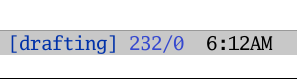
“Drafting” is the name of the current branch, the first number is the amount of current changes made on the project, and the number after the slash is how many commits have been made today.
This has been incredibly helpful for a few reasons. It’s given me sensible metrics I can hit on a regular basis. This makes planning out effort much easier.
In the past I’ve tended to get excited early in a project and work too fast and aggressively and burn out, take some time off, and come back later to finish. Having more sensible targets early on, and a better scope of what I want to accomplish, helps me stay on track without burning out.
Likewise, this helps me make sure I’ve put enough thought into something before sending out into the world. You don’t want to send out a cake half-baked. Seeing that I’ve put a lot of commits on something is an easy way of gauging the effort I’ve expended.
The process emphasizes strategy. By stopping periodically to see what I’ve done, I can approach the work with more sensitivity. I can see where I’m putting effort and where I might need more or less.
This seems like an excellent approach.