
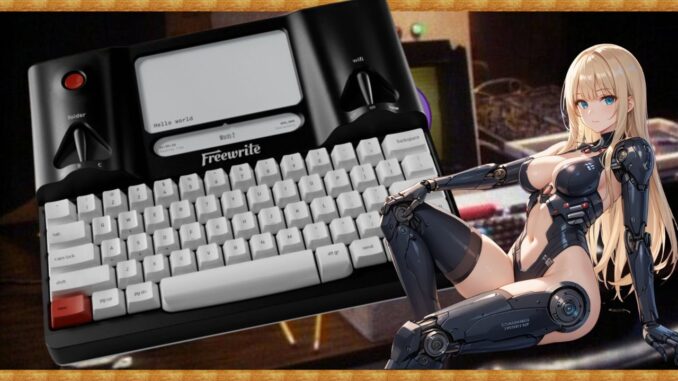
I’ve been seeing a lot of videos and articles recently about writerdecks. That’s right. These are distraction-free writing environments for writers. Basically, specialty computer rigs only for writing. This means a bare bones, stripped down computing environment for output of words onto a screen. How many different ways can I say it? (I think the last description is most accurate, but I’m not going to delete the other ones.)
You can get a premium writerdeck for about $600. Or, you can make your own from an old computer lying around the house or a cheap mini computer (like a Raspberry Pi). The latter may require some tech know-how and extra patience.
I love the idea. I think anything that encourages people to sit down and focus on writing is good.
Though, one must be careful to not confuse the thing itself with the result of the thing. Now, what do I mean by that?
The low-tech “distraction-free” writing content you see in blog posts and YouTube videos does a little fast-forward thinking to get you to think past the sale a little bit. They always start out with “distraction-free writing is good.” Good. Agreed. Then they start selling you on a writerdeck.
The result of the thing is not always the thing itself. You don’t need a writerdeck to do some distraction-free writing. You can just pick up a legal pad and some Bic pens from the drug store and you’re golden.
A healthy digression. Is there really such a thing as true, distraction-free writing? At best, even if you have a writerdeck with no Internet connection, and you’re alone in a cabin in the woods, you might achieve a much-vaunted “minimal distraction writing” environment. (For which I would still very much applaud you.)
For the price of a yellow legal pad (yellow is the best kind, but white will do), some Bic pens—and maybe some earplugs—you’ve got as sophisticated a minimal writing apparatus as you can get.
I speak from experience, I’ve got both a paper/pen setup and a minimalist Raspberry Pi writerdeck running DietPi with no GUI. Don’t get me wrong, I love the Pi. But even with no GUI, the paper has a natural feel that seems to just melt the words off your brain and through your hand and onto the page. There’s no easier or more fluid way to get your ideas down. Then, you can always upload your words into digital snot and share them with the world.
To reiterate…
I love the writerdeck aesthetic. I encourage any trend or cultural movement that gets people off social media and creating art (particularly with their words). But there’s no need to confuse the result of the thing (fewer distractions, more writing) with the thing itself (paper, pen, writerdeck, whatever).
A little note about paper though, if you’ll indulge me. There’s a difference between how one works with legal pads and notebooks. I suggest you try both. A notebook is good for capturing ideas and freewriting. But if you’re working on an individual piece, like a novel or blog post, go for the legal pad, which is designed to let you easily tear the pages out and organize or re-arrange them as you see fit. The latter is more suited for manuscripts and documentation than the notebook.
That’s all I had to say today. As always, if you want to support my efforts to help creative professionals drain more value from their brains without burning out, you can take a look at my bookstore and maybe buy something. Catch ya later.
Disclaimer: this article was written in minimalist computer writing environment.
Leave a Reply