
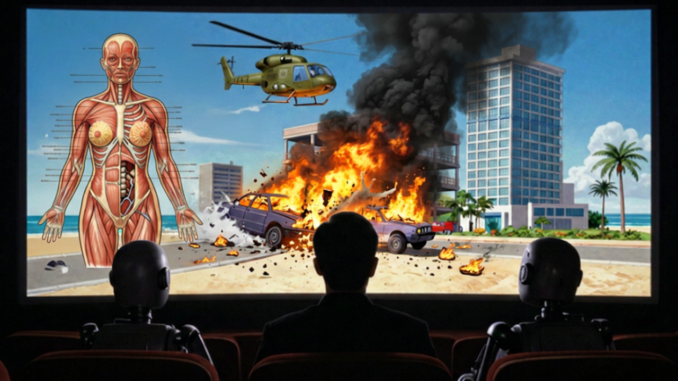
The human organism is an atrocity exhibition at which he is an unwilling spectator.
The setup. The Atrocity Exhibition by J.G. Ballard is not a conventional novel. It is a sequence of fifteen “condensed” or conceptual novels, each chapter built out of short, blocky paragraphs, most of them carrying their own little section title. It took me about five hours to read, spread across several non-consecutive sittings. The extracts that make up the book were originally published in different places, so it reads as a collection of pieces gathered around a set of shared themes rather than a single continuous story.
A lonely guy. The recurring protagonist is a “T-character” whose name shifts from chapter to chapter: sometimes Travis, sometimes Talbot, sometimes Tallis, sometimes Traven. He seems to be undergoing some kind of nervous breakdown or to be under clinical care, observed in several sections by a recurring academic figure named Dr. Nathan, who studies him. Repeating motifs run throughout: an “atrocity exhibition” of films and images of violence, car crashes and wounds displayed in galleries and on screens, multi-story car parks (what we would call parking garages), apartment blocks, drained rivers, and a helicopter that flies through again and again, which I read as a recurring note of surveillance. The settings tend toward a post-apocalyptic desolation, though it never quite reads as science fiction. Two of Ballard’s most notorious satirical pieces are collected here: Why I Want to Fuck Ronald Reagan and The Assassination of John Fitzgerald Kennedy Considered as a Downhill Motor Race. The book does not need to be read front to back; each chapter works as its own compressed novel.
My favorite chapter. The chapter I want to walk through is Chapter 7, The Summer Cannibals, one of the calmer and most beautiful pieces in the book. It plays out at a deserted Mediterranean beach resort: white pumice beaches, a few bars, apartment blocks in ice-cream colors, a drained river, a motor bridge, an open-air cinema, and a multi-story car park. In the opening section, “Locus Solus,” a woman sits in a dust-covered car and watches a man wander along the beach with some ambivalence; he returns carrying an odd-shaped stone. From there the titled sections move through the interior of their apartment (“The Yes or No of the Borderzone”); the man following a young woman through an arcade to the open-air cinema, where she works a pay kiosk (“B-Movie”); scenes in bed, with the magnified body of Bardot filling the cinema screen above the rooftops (“Love Among the Mannequins”); an expedition down to the drained river with a camera (“A Confusion of Mathematical Models”); and a string of sexual encounters rendered in cool, anatomical detail (“Soft Geometry,” “A Krafft-Ebing of Geometry and Posture,” “Elements of an Orgasm,” which is literally a numbered list of conjunctions between the woman’s body and a car).
The drifting man and the car park. Across these sections the man drifts between his wife and the young woman from the cinema, the emotional distance between him and the wife widening until, as he puts it in “Non-Communicating Dialogue,” an enormous neutral ground divides them, across which their emotions signal like “meaningless semaphores.” In “Imaginary Perversions” he delivers a small monologue: sex has become a conceptual act, sexual perversions are morally neutral, and we need to invent new imaginary perversions just to keep our feelings alive. The chapter then turns violent. He drives into the oncoming lane (“Contours of Desire”); there is a crash, blood, a body across a car seat, the woman vomiting onto the sand and climbing back to the road (“Some Bloody Accident”); he chases her running figure in the car, cutting the headlamps and steering from side to side so that her position keeps shifting against the roadside billboards, the cinema screen, and the car park (“Love Scene”); and it closes with her waiting in the car, studying newspaper photographs of an automobile accident, as the last of a stranger’s footprints fill in with sand (“Zone of Nothing”). This final woman seems to be his wife, who is quietly aware of the man’s “affairs,” though it is often hard to tell which woman is which from section to section, and it does not seem to matter much.
Annotations. Each chapter ends with the author’s own annotations, a kind of footnote apparatus. For The Summer Cannibals these explain that “Locus Solus” is named after a work by Raymond Roussel, that the resort is a generalized vision of San Juan near Alicante in Spain (where, the note says plainly, Ballard’s wife died in 1964), and they riff on the Mediterranean beach as a single linear city three thousand miles long. The notes confirm this is a Traven chapter with two women, a saner version of the character set apart from the larger concerns of the rest of the book.
Leave a Reply